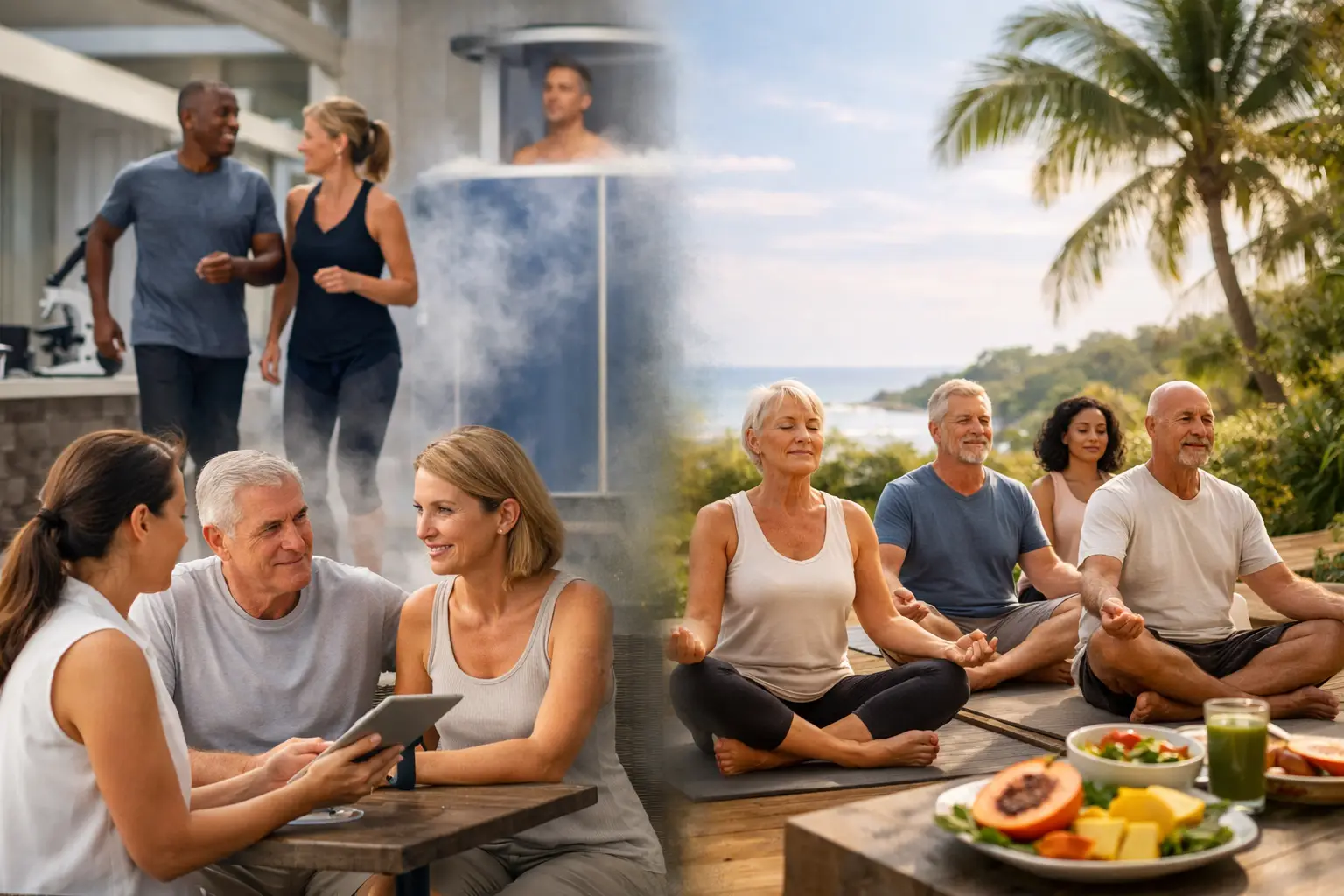
A beautiful setting can help you exhale. It cannot, on its own, rebuild strength, improve balance, or give you a plan for the next decade. That is the real distinction in a longevity retreat vs wellness retreat: one may offer a restorative break from daily life, while the other is designed to help you perform better within it.
For adults in their second prime, this difference matters. You may not be looking for another escape. You may be looking for a structured way to restore energy, protect independence, build confidence in your body, and make your health choices more intentional.
Longevity Retreat vs Wellness Retreat: The Core Difference
A wellness retreat is typically centered on feeling better in the present. It may include spa treatments, yoga, meditation, healthy meals, nature experiences, sleep, and time away from work or family demands. These elements can be valuable, especially when stress has been running the show. A few days of rest can create mental space and remind you what it feels like to be well cared for.
A longevity retreat takes a longer view. Its purpose is not merely to help you feel refreshed by the end of the week. It is to help you understand and improve the physical, metabolic, and behavioral foundations that influence how you function in the years ahead.
That usually means targeted strength training, mobility assessment and practice, nutrition education, recovery strategies, stress resilience work, and personalized planning. The experience still needs to be enjoyable. But enjoyment supports the work rather than replacing it.
The distinction is not that wellness retreats are frivolous or that longevity retreats should feel clinical. The question is whether the program is built around temporary relief or lasting capability.
What a Wellness Retreat Usually Delivers
A strong wellness retreat can be exactly right when you are depleted, overstimulated, or simply craving permission to slow down. The best programs create conditions many people struggle to create at home: regular meals, fewer decisions, time outdoors, movement without pressure, and real rest.
You may return feeling lighter, calmer, and more connected to yourself. For someone coming off an intense season at work, caregiving demands, or prolonged stress, that reset has real value.
The trade-off is that many wellness retreats are broad by design. Their schedule often serves a wide range of ages, abilities, and goals. A 30-year-old looking for a yoga holiday and a 62-year-old navigating muscle loss, joint stiffness, and changing metabolism may attend the same class, receive the same general nutrition messaging, and leave with no individualized strategy.
Wellness programming can also lean heavily toward passive recovery. Massage, meditation, hydrotherapy, and sleep support are meaningful tools, but they cannot substitute for progressive resistance training, protein habits, or the movement practice needed to preserve strength and bone health.
What Makes a Longevity Retreat Different
A longevity retreat is built for the realities of aging well. It recognizes that after 45, health is not measured only by the number on a scale or how relaxed you feel on vacation. It is reflected in whether you can carry luggage without strain, rise from the floor with confidence, maintain muscle, stay mentally sharp under pressure, and keep saying yes to the life you want to lead.
The most effective programs focus on practical pillars that compound over time.
Strength and mobility are treated as non-negotiable
Strength is one of the clearest expressions of independence. It supports posture, joint stability, metabolic health, balance, bone density, and everyday confidence. A longevity-focused experience should teach you how to train safely at your current level, not push you into an extreme fitness challenge that leaves you sore, discouraged, or injured.
Mobility work should be equally purposeful. The goal is not to force your body into impressive positions. It is to improve usable range of motion, reduce restrictions that affect daily movement, and help you move with more control.
Nutrition becomes a strategy, not a set of rules
Generic advice to eat clean is rarely enough. Adults in midlife often need clearer guidance around protein intake, meal structure, energy balance, blood sugar stability, hydration, and recovery. Hormonal shifts, travel schedules, stress, sleep disruption, and years of dieting can all influence what works.
A quality longevity retreat teaches principles you can apply at a business dinner, in an airport, or during a demanding workweek. The aim is not a short-term food plan. It is a way of eating that supports lean muscle, steady energy, and long-term metabolic health.
Recovery is active and measurable
Recovery matters, but it should be more than a spa menu. In a longevity setting, recovery may include sleep education, breathwork, mobility, stress-management practices, cold or heat exposure where appropriate, and guidance on how to balance training with rest.
The key is context. More intensity is not always better, especially if you are already tired, under-muscled, or carrying a high stress load. The right plan helps you recognize when to challenge yourself and when to recover with intention.
The program acknowledges age-specific needs
Midlife is not a generic category. Men and women can face different transitions related to hormones, body composition, bone density, cardiovascular risk, and recovery capacity. A thoughtful retreat makes room for shared learning and also provides relevant, gender-specific instruction.
This is one reason a small-group format can be so powerful. You are not expected to fit a one-size-fits-all protocol. You receive coaching that respects where you are now while holding you accountable to where you want to go.
Choose Based on Your Outcome, Not the Itinerary
When comparing options, look beyond the photos, destination, and number of amenities. Ask what you want to be different six months after you return home.
If your primary goal is to rest, reconnect, and step away from a demanding routine, a wellness retreat may be the right choice. There is no need to turn every getaway into a performance project. Restoration is a legitimate need.
If you are concerned about declining energy, weight gain, reduced mobility, loss of strength, stress-driven habits, or uncertainty about how to age well, a longevity retreat is likely the better fit. You need more than inspiration. You need education, expert feedback, and a plan you can execute when real life resumes.
The strongest longevity experiences also preserve what people love about a retreat: exceptional surroundings, nourishing food, supportive connection, and space to think clearly. The difference is that the experience has a defined purpose. You leave not just feeling renewed, but knowing what to do next.
Questions to Ask Before You Book
A retreat’s language can sound impressive without revealing much about its substance. Before you commit, ask how the program assesses your starting point, how movement is adapted for injuries or varied fitness levels, and whether the coaches have experience working with adults over 45.
Ask what happens after the final session. Will you leave with a personalized action plan? Do you understand how to continue training, eating, and recovering at home? Is there a clear framework for turning a meaningful week into sustainable habits?
Also consider the group itself. The right environment should feel aspirational, not intimidating. Being surrounded by capable people who are also committed to reinvention can raise your standards. But you should never feel pressured to prove that you belong.
At 2nd PRIME Built, the model is intentionally designed around this second-prime stage: structured training and education, recovery and resilience practices, shared momentum, and targeted guidance for the distinct needs of men and women. The point is not to chase youth. It is to build the strength, clarity, and discipline to make your next chapter your most capable one.
Your Best Retreat Should Change the Return Home
The value of a retreat is not measured by how relaxed you feel at checkout. It is measured by what remains when your calendar fills up again. A wellness retreat can give you a needed pause. A longevity retreat can help you build a new baseline.
Choose the experience that meets your honest need right now. Then protect what you learn by scheduling the first workout, planning the next few meals, and keeping one recovery practice before the momentum has a chance to fade. Your second prime is not waiting for the perfect moment. It is built through the choices you are ready to repeat.