A bone scan can feel like a wake-up call, but it does not have to become a verdict on what is possible next. The best exercises for bone density give your skeleton a clear reason to adapt: regular, appropriately scaled force. For adults over 45, that means moving beyond the idea that exercise is only about burning calories and building a training practice that protects your strength, posture, confidence, and independence.
Bone is living tissue. It responds to the loads placed on it, especially when those loads are progressive, varied, and repeated over time. The goal is not to train like a 25-year-old or punish your body with high-impact workouts. The goal is to create enough of the right stimulus to stay durable for the life you want to lead.
Why Bone Density Needs a Training Plan
Bone density tends to decline with age, with a sharper shift for many women during and after menopause as estrogen levels change. Men are not immune, either. Lower testosterone, inactivity, certain medications, low body weight, poor nutrition, and chronic stress can all affect bone health over time.
Walking, swimming, and cycling can be excellent for cardiovascular health, mood, and mobility. But they do not consistently provide the mechanical loading needed to meaningfully challenge the hips, spine, and wrists – the areas where fractures can have the greatest impact on later-life independence.
The strongest plan pairs two types of training: resistance work that asks muscles to pull on bone, and weight-bearing or impact activity that asks the skeleton to absorb force. Balance and mobility complete the picture by reducing the likelihood of a fall in the first place.
The Best Exercises for Bone Density: 7 Smart Choices
1. Squats and Sit-to-Stands
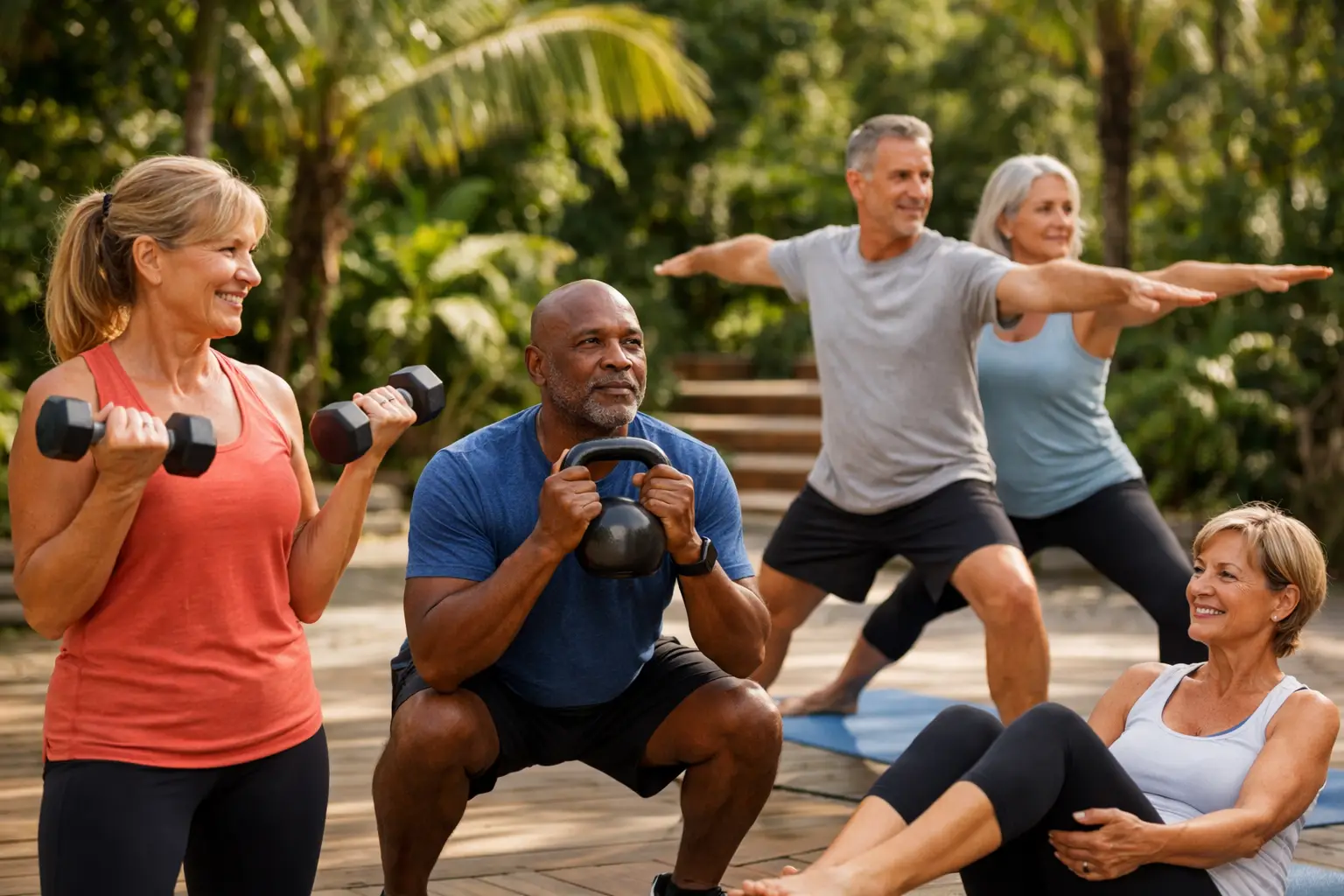
Squats load the hips, legs, and spine while building the lower-body strength needed for stairs, travel, getting up from the floor, and everyday resilience. A bodyweight squat to a box or bench is a strong place to start. As control improves, add a dumbbell held at the chest, then gradually increase resistance.
If knee discomfort limits your range, raise the seat height and work within a pain-free motion. The standard is not how low you can go. It is whether you can move with stable feet, a tall chest, controlled knees, and enough challenge to improve.
2. Deadlifts and Hip Hinge Variations
A well-coached deadlift is one of the most valuable movements for healthy aging. It trains the hips, hamstrings, glutes, upper back, and trunk while teaching you how to pick up objects without folding through the low back.
Start with a kettlebell or dumbbells elevated on blocks, or use a Romanian deadlift with light weights. The movement should feel like your hips moving back, not your spine rounding forward. For people with osteoporosis or a history of vertebral compression fractures, this distinction matters: loaded, repeated spinal flexion is generally not the right choice. Get individual guidance before progressing this pattern.
3. Step-Ups and Stair Climbing
Step-ups are practical, scalable, and highly relevant to real life. They place weight through one leg at a time, challenge the hip, and improve balance and leg strength. Use a low step first, hold a rail or wall for support if needed, and drive through the full foot rather than pushing off excessively with the trailing leg.
Stair climbing is also useful, particularly for those not yet ready for higher-impact work. It will not replace progressive strength training, but it is a simple way to add regular weight-bearing volume to your week.
4. Overhead Presses and Loaded Carries
Bone health is not only a hip issue. The upper body matters, particularly when it comes to posture, reaching, lifting luggage, and breaking a fall. Dumbbell overhead presses can load the arms, shoulders, and upper spine when performed with good alignment.
Loaded carries are equally powerful. Hold dumbbells or kettlebells at your sides and walk slowly with a tall posture, steady breathing, and controlled steps. Carries train grip strength, trunk stability, gait, and the ability to transfer force through the entire body. They are a direct investment in capability.
5. Rows and Pulling Exercises
Rows may not look dramatic, but they are foundational for a strong upper back and better posture. Cable rows, resistance-band rows, chest-supported dumbbell rows, and machine rows can all help strengthen the muscles that support the spine and shoulder blades.
This is especially valuable for adults who spend years at a desk, in a car, or looking down at devices. A stronger back does not automatically prevent fractures, but it supports safer mechanics and helps counter the rounded posture that can develop with age and inactivity.
6. Low-Level Jumps, Hops, or Heel Drops
Impact can be a potent bone-building signal, but it must match your starting point. For a person with healthy joints, good balance, and no diagnosis of osteoporosis, small jumps, hopping drills, or brisk multidirectional stepping may be appropriate. These activities introduce brief, higher forces that bones respond to well.
For someone new to impact, heel drops can be a more accessible option: rise onto the balls of the feet, then lower the heels with a firm but controlled landing. Marching with purpose, quick step-ups, and short bouts of light skipping may also provide a bridge toward more dynamic work.
This is not a universal prescription. If you have osteoporosis, osteopenia with fracture risk, joint pain, a recent injury, or concerns about balance, speak with your physician or a qualified physical therapist before adding impact. More force is not always better. The right dose is the one you can perform safely and consistently.
7. Tai Chi, Single-Leg Stands, and Balance Training
Balance exercises do not directly build bone density in the same way a squat or carry can. Their role is just as strategic: they lower fall risk. A fracture often begins with a trip, a rushed turn, or a missed step, not a lack of determination.
Practice standing on one leg near a counter, walking heel-to-toe, changing direction slowly, or taking a Tai Chi class. Add these movements in short doses several times a week. Better balance also makes strength and impact training more confident and more productive.
How to Build a Bone-Strengthening Week
For most adults, two to three full-body resistance sessions each week is a practical foundation. Include a squat or step-up pattern, a hinge, an upper-body push, an upper-body pull, and a carry. Choose weights that make the last few repetitions feel demanding while allowing controlled form. Over time, progress by adding a small amount of weight, another repetition, or a more challenging variation.
Add weight-bearing activity on most days. This might be brisk walking, hiking, stairs, dancing, or recreational court sports. If impact is appropriate for you, begin with brief, planned exposure once or twice a week rather than launching into long jump sessions. Your tendons, joints, and nervous system need time to adapt alongside your bones.
Recovery belongs in the plan, too. Bone remodeling is supported by adequate protein, sufficient calories, vitamin D and calcium when needed, quality sleep, and a training schedule you can sustain. Extreme dieting, excessive endurance volume without strength work, and constant high-intensity training can work against the very outcomes you want.
Train for Strength, Not Fear
If you have been told you have osteopenia or osteoporosis, do not assume your only option is to become fragile and cautious. You may need more thoughtful exercise selection, professional guidance, and a slower progression. You do not need to stop building strength.
A coach who understands midlife training can help you distinguish productive challenge from unnecessary risk. At 2nd PRIME Built, this is the work: creating a structured path that respects your current capacity while building toward the stronger, more capable body you want to carry into your next chapter.
Your bones respond to what you repeatedly ask of them. Start where you are, train with intention, and let every controlled lift, step, and carry become evidence that your second prime is built through action.

One Response