A missed curb, a rushed turn while carrying groceries, or the moment you hesitate before stepping off a boat can reveal more than an awkward wobble. Balance is one of the clearest signals of how confidently you can move through life. Learning how to improve balance after 60 is not about standing on one foot for bragging rights. It is about protecting your freedom to travel, train, play, and live on your own terms.
The good news is that balance is trainable. It is not a fixed trait that disappears with age. With the right combination of lower-body strength, mobility, reaction training, and consistent practice, you can build a more stable, capable body for the years ahead.
Why Balance Changes After 60
Balance is a full-body skill. Your brain receives information from your eyes, inner ear, joints, muscles, and the soles of your feet, then decides how your body should respond. A small shift in position may require your ankle to react, your hip to stabilize, your core to brace, and your foot to adjust – all in a fraction of a second.
After 60, this system can become less efficient for several reasons. Muscle mass and power may decline if strength training has been inconsistent. Stiff hips and ankles can limit your ability to make quick corrections. Vision changes, certain medications, sleep disruption, and reduced activity can also affect stability. For women, hormonal transitions can influence muscle and bone health. For men, declining activity and metabolic health can gradually erode strength and coordination.
None of this means instability is inevitable. It means your training needs to become more intentional. Walking is valuable, but walking alone rarely challenges the strength, range of motion, and reaction speed needed to prevent a fall when life becomes unpredictable.
How to Improve Balance After 60: Train the Foundation
The strongest balance plan begins with a simple principle: build the physical capacity to catch yourself. That means training strength before chasing difficult balance drills.
Build stronger legs and hips
Your glutes, quads, hamstrings, calves, and hip stabilizers are your first line of defense when you trip or lose footing. The ability to recover from a stumble depends less on perfect posture and more on whether your legs can produce force quickly and control your body weight.
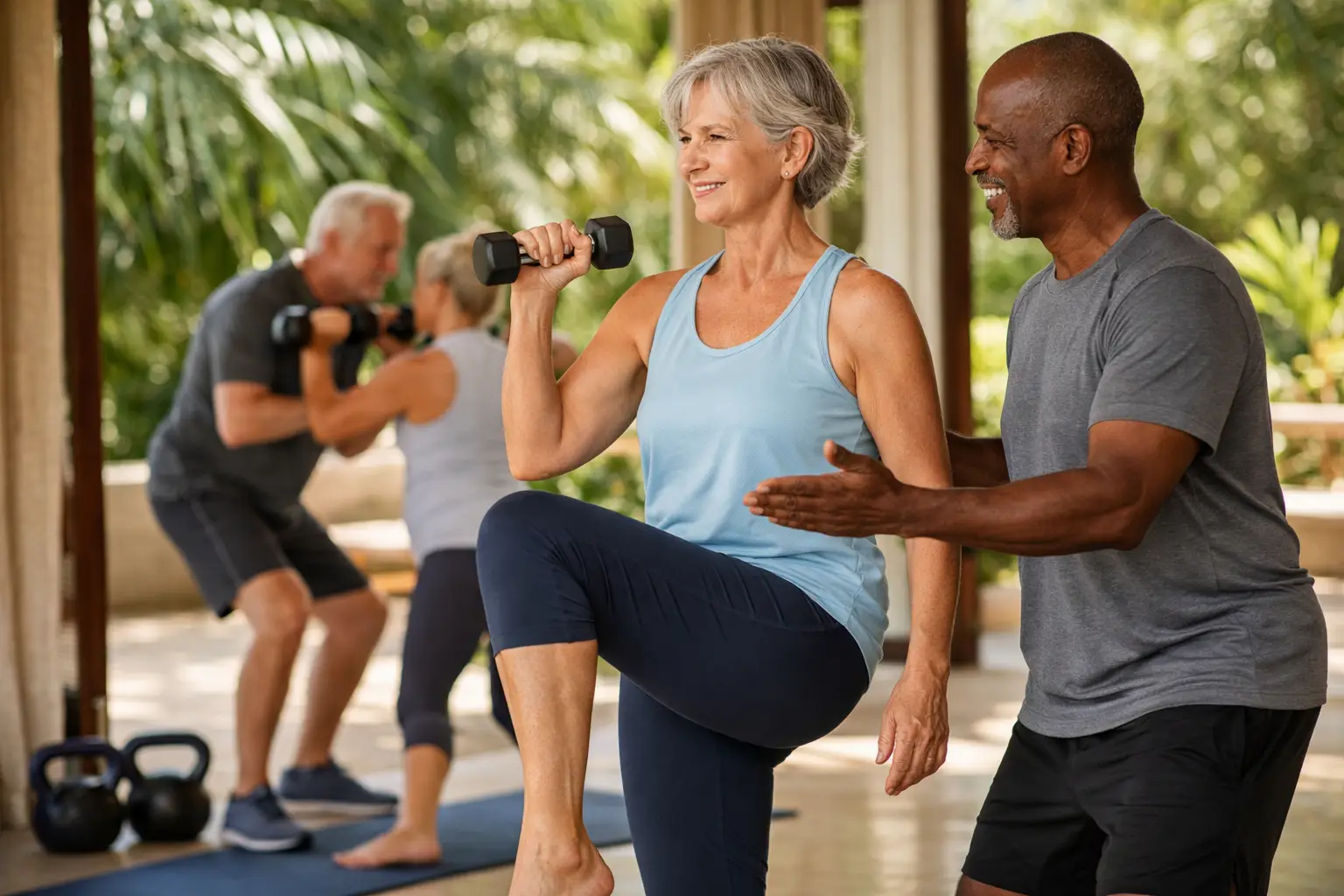
Prioritize movements such as chair squats, supported split squats, step-ups, hip hinges, calf raises, and lateral band walks. Start with a range of motion you can control. A squat to a chair is not a lesser version of exercise. It is a smart way to build strength, confidence, and sound mechanics.
Train two or three days per week, leaving at least a day between challenging lower-body sessions. Use enough resistance that the final few repetitions feel demanding while your form remains steady. If every exercise feels effortless, your body has little reason to adapt.
Restore ankle and hip mobility
A stable body needs options. If your ankle cannot bend enough as you step down a slope, your body may compensate by shifting your trunk or collapsing the knee inward. If your hips are stiff, turning quickly or stepping sideways becomes harder than it should be.
Include controlled ankle circles, calf stretches, knee-over-toe ankle rocks, hip flexor stretches, and gentle hip rotation work in your weekly routine. Mobility is most useful when you actively use it. Pair flexibility work with strength movements that reinforce your new range, such as slow step-downs and split squats.
Train your feet, not just your shoes
Supportive footwear has a place, especially on uneven terrain or during recovery from foot pain. But feet also need sensory input and strength. Spend short, safe periods barefoot at home if your foot health allows it. Practice spreading your toes, gently shifting weight from heel to forefoot, and maintaining a stable tripod through the heel, base of the big toe, and base of the little toe.
This is not a reason to abandon shoes or ignore podiatry advice. It is a reminder that your feet are active participants in balance, not passive platforms.
Practice Balance in Ways That Transfer to Life
Once strength work is in place, add targeted balance practice three to five days each week. Five to 10 focused minutes can create meaningful progress when repeated consistently. Always begin near a countertop, sturdy chair, or wall so support is available immediately.
Start with a stance you can own. Stand with feet together for 20 to 30 seconds, then progress to a staggered stance with one foot slightly ahead of the other. From there, try a supported single-leg stand. The goal is not to white-knuckle your way through a minute. The goal is calm control, steady breathing, and the ability to correct small movements without panic.
As your confidence grows, make one variable more challenging at a time. You might turn your head slowly from side to side, reach one arm forward, stand on a folded towel, or perform gentle weight shifts. Avoid closing your eyes until you have a strong foundation and a safe setup. Removing vision dramatically increases difficulty and is not necessary for everyone.
Dynamic drills matter, too, because most falls happen while moving. Practice controlled heel-to-toe walking along a counter, side-stepping, slow backward walking with support nearby, and stepping over a low object. These drills teach your body to manage direction changes, uneven surfaces, and divided attention without becoming rigid.
Add Power and Reaction, Safely
Strength helps you stay upright. Power helps you recover quickly. The difference matters when your toe catches a rug or a dog changes direction at your feet.
Power training after 60 does not need to mean jumping. It can be as simple as standing up from a chair with purposeful speed, stepping onto a low platform with a firm drive through the front foot, or performing quick but controlled calf raises. The lowering phase should remain deliberate. Speed without control is not power training – it is just risk.
Reaction can also be trained. Have a coach or training partner give a verbal cue to step right, left, forward, or back. Toss and catch a light ball while standing in a staggered stance. Walk at an easy pace while naming items in a category, such as cities or foods. These exercises prepare you for real life, where balance challenges often arrive when your attention is elsewhere.
Make Your Environment Work for You
Training improves capacity, but a smart environment reduces unnecessary risk. Review your home with an honest eye. Loose rugs, dim hallways, cluttered stairs, slippery bathroom floors, and shoes left in walkways can turn a minor misstep into a major event.
Use lighting that makes nighttime trips to the bathroom safer. Keep frequently used items within easy reach. Choose footwear with secure heels and soles suited to the conditions. If you wear progressive lenses, give yourself a moment to adjust when approaching curbs or stairs, since the lower part of the lens can alter depth perception.
This is not about living cautiously. It is about directing your energy toward the challenges that build you rather than the hazards that drain confidence.
Know When to Get Professional Guidance
A sudden change in balance deserves attention. Speak with a health care professional if you experience new dizziness, fainting, numbness, repeated falls, a noticeable change in walking, severe headaches, chest pain, or weakness on one side of the body. Review medications if you feel unsteady, particularly after starting or changing a prescription.
A physical therapist can assess gait, joint mobility, strength asymmetries, vestibular function, and movement patterns. This is particularly valuable after a fall, surgery, injury, or long period of inactivity. Personalized coaching can help you progress without guessing, especially if arthritis, osteoporosis, neuropathy, or joint replacement is part of your health picture.
A Better Standard for Your Second Prime
Balance is not separate from the rest of your health. It reflects your strength, mobility, attention, recovery, and willingness to keep challenging your body. The person who can step confidently onto a trail, carry luggage through an airport, get down to the floor and rise again, or pivot quickly on a tennis court is not merely avoiding falls. They are preserving a wider life.
Start where you are, train with consistency, and respect gradual progress. Your next prime can be defined by steadier steps, stronger legs, and the confidence to say yes to the experiences that still call you forward.