You notice it in ordinary moments first. The suitcase feels heavier than it used to. Getting up from the floor takes more effort. Your usual workout still happens, but the power is not quite there. If you have been asking, why am I losing strength with age, the answer is not simply that you are getting older. It is that several systems that support strength begin to change at once, and most people are never taught how to train for that new reality.
That distinction matters. Strength loss in midlife and beyond is common, but it is not a sentence. For many adults, it is a signal – a sign that the body now needs more precise inputs around training, recovery, nutrition, hormones, and stress. When those inputs improve, strength often returns faster than people expect.
Why am I losing strength with age? It is usually not just one thing
Muscle strength does not depend on muscle alone. It depends on your nervous system, joints, connective tissue, sleep, recovery capacity, and metabolic health. With age, each of those can shift.
One major factor is sarcopenia, the gradual loss of muscle mass that tends to accelerate after 40 and becomes more noticeable after 50. But muscle size is only part of the story. Many adults also lose power, which is your ability to produce force quickly. That is why stairs feel steeper, balance feels less automatic, and everyday tasks can seem surprisingly demanding even if you still look relatively fit.
Another factor is anabolic resistance. In simple terms, the body becomes less responsive to the signals that build and maintain muscle. The same walk, the same light dumbbells, and the same casual eating pattern that once kept you strong may no longer be enough. Your body now asks for a clearer message.
Hormonal changes also play a role. For women, perimenopause and menopause can affect muscle retention, recovery, sleep quality, bone density, and body composition. For men, declining testosterone, poor sleep, rising stress, and metabolic dysfunction can gradually erode strength and performance. This does not mean hormones are always the main issue, but they often shape how well your body responds to training.
Then there is inactivity, even in people who do not think of themselves as inactive. You can be busy, successful, and on your feet all day yet still miss the kind of progressive resistance training that preserves strength. Movement is good. Specific loading is better.
The hidden drivers of age-related strength loss
Most adults assume they are losing strength because they are doing less. Sometimes that is true. Just as often, they are doing the wrong kind of work for this stage of life.
Endless cardio, random classes, and occasional weekend workouts can keep you active without making you stronger. Strength is built through progression. Your muscles, tendons, and nervous system need a training plan that gradually increases challenge while respecting recovery. Without that progression, the body adapts very little.
Under-eating protein is another frequent problem. Many adults in midlife eat reasonably well but still fall short on the amount of protein needed to support muscle repair and growth. If you are training without enough protein, you are asking the body to rebuild with limited materials.
Sleep disruption can be just as damaging. Poor sleep reduces recovery, affects insulin sensitivity, lowers training performance, and increases cravings that can undermine body composition. If your sleep has changed in your 40s, 50s, or 60s, strength loss may reflect recovery debt as much as training quality.
Chronic stress deserves attention too. High-achieving adults often carry a constant stress load from business, caregiving, travel, and mental overdrive. That state does not just affect mood. It influences inflammation, hormone balance, motivation, and the capacity to recover from exercise. The body can get stuck in survival mode when what you need is adaptation mode.
Why your old fitness strategy may have stopped working
There is a reason many people say, I am exercising, but I still feel weaker. Midlife changes the rules. Not completely, but enough that old methods can lose their edge.
In your 20s and 30s, you could often get away with inconsistency. You could train hard, recover fast, and maintain muscle with less intention. In your second prime, the body rewards strategy over punishment. More is not always better. Better is better.
That means training has to become more intelligent. Heavy enough to stimulate change. Controlled enough to protect joints. Consistent enough to create momentum. Supported enough by mobility, recovery, and nutrition to actually produce results.
This is also where many adults make the wrong trade-off. They become cautious and stop challenging the body, or they try to prove they still have it by training like they did at 28. Neither approach works well for long. The goal is not to go backward. The goal is to train for the body you have now and the future you want.
What helps restore strength after 45
The good news is that strength is highly trainable well into later decades. People in their 50s, 60s, and 70s can gain muscle, improve balance, build bone-supporting force, and feel dramatically more capable. But the inputs have to match the outcome.
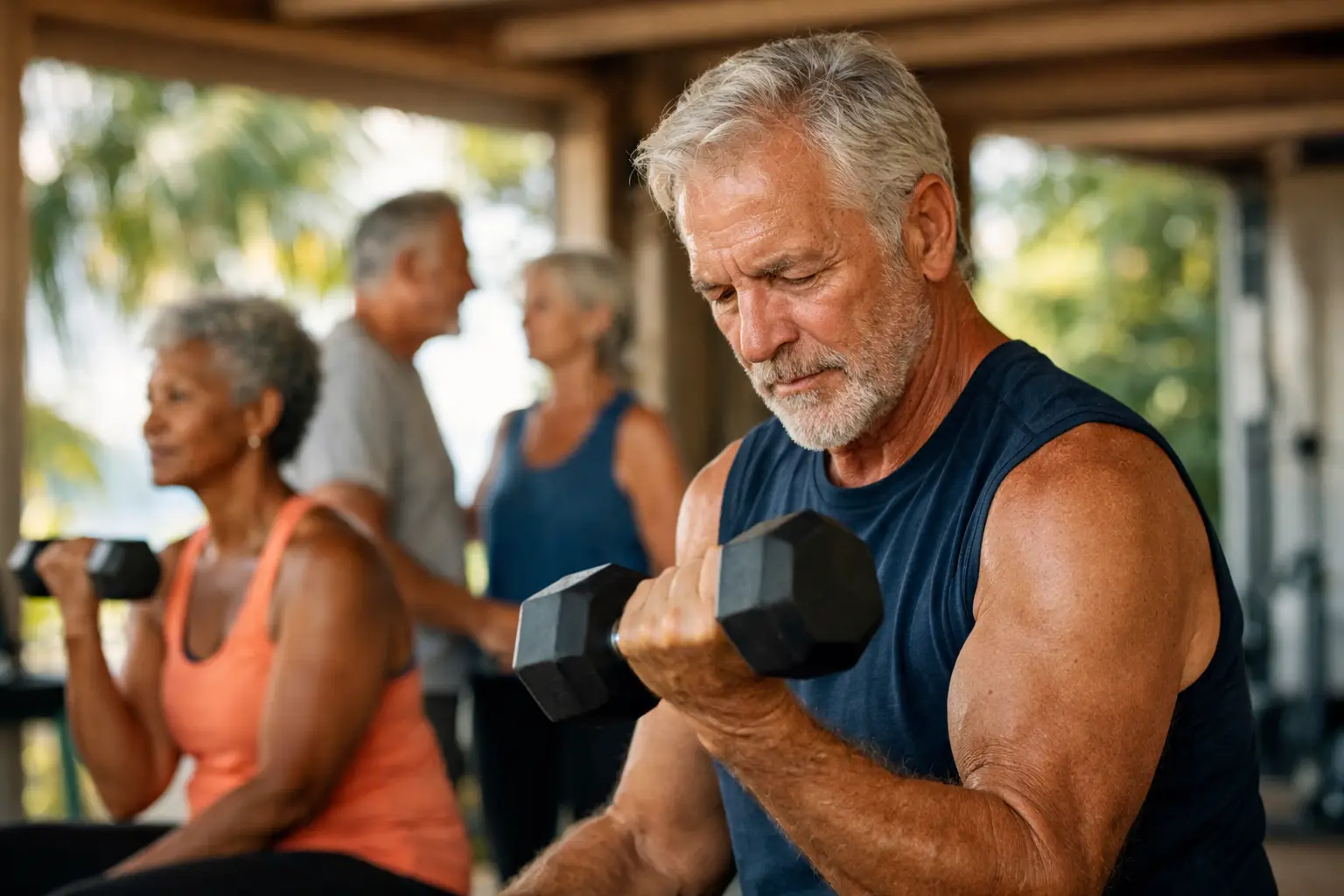
Start with resistance training. This is the foundation. You do not need chaos, punishment, or extreme workouts. You need a structured program built around major movement patterns like squatting, hinging, pushing, pulling, carrying, and getting up from the floor. Those patterns matter because they support real-life function, not just gym performance.
Progressive overload matters, but so does pacing. That means adding challenge over time through weight, reps, tempo, range of motion, or stability demands. It does not mean maxing out constantly. For adults managing joint sensitivity, past injuries, or long gaps in training, smart progression beats aggressive intensity.
Protein intake should rise to meet the demands of training and healthy aging. Many adults benefit from distributing protein across meals instead of saving most of it for dinner. Hydration, fiber, and overall nutrient quality matter too, but protein is often the missing lever for strength.
Mobility and recovery are not extras. They are part of the program. Stiff hips, limited thoracic mobility, poor ankle motion, and chronic tension can make strength training less effective and less safe. Mobility work helps you access better positions. Recovery practices help you repeat quality training week after week.
Finally, pay attention to power. This is often the forgotten quality in aging bodies. Strength is force. Power is force produced quickly. Simple age-appropriate power training, when coached well, can support balance, reaction time, and confidence. It is one reason some people stop feeling old when they start training properly.
When strength loss may be a medical issue
If the decline feels rapid, extreme, or paired with unusual fatigue, pain, shortness of breath, numbness, or unexplained weight loss, medical evaluation matters. Low iron, thyroid issues, medication effects, inflammatory conditions, neurologic problems, and severe hormone disruption can all affect strength.
This is where nuance matters. Not every drop in performance is a training issue. Sometimes the smartest move is to rule out what does not belong before pushing harder.
The deeper question behind why am I losing strength with age
For many adults, this question is not really about the gym. It is about identity. Strength represents independence, confidence, attractiveness, capability, and self-trust. When it slips, it can feel personal.
That is exactly why the response should be intentional. This season of life asks for a new framework, not resignation. You are not trying to preserve youth at all costs. You are building a body that can carry your ambition, your family, your travel, your work, and your freedom for decades to come.
At 2nd PRIME Built, this is the central shift we believe in: aging is not a retreat from performance. It is a call to train with greater precision, recover with greater discipline, and live with greater purpose. The body can become strong again, but it responds best when the plan respects the biology of this stage.
If you feel weaker than you used to, do not read that as the end of your peak. Read it as feedback. Your body is asking for a better strategy, and when you answer it well, strength often becomes more than muscle. It becomes proof that your next chapter can be your most capable one yet.


2 Responses